
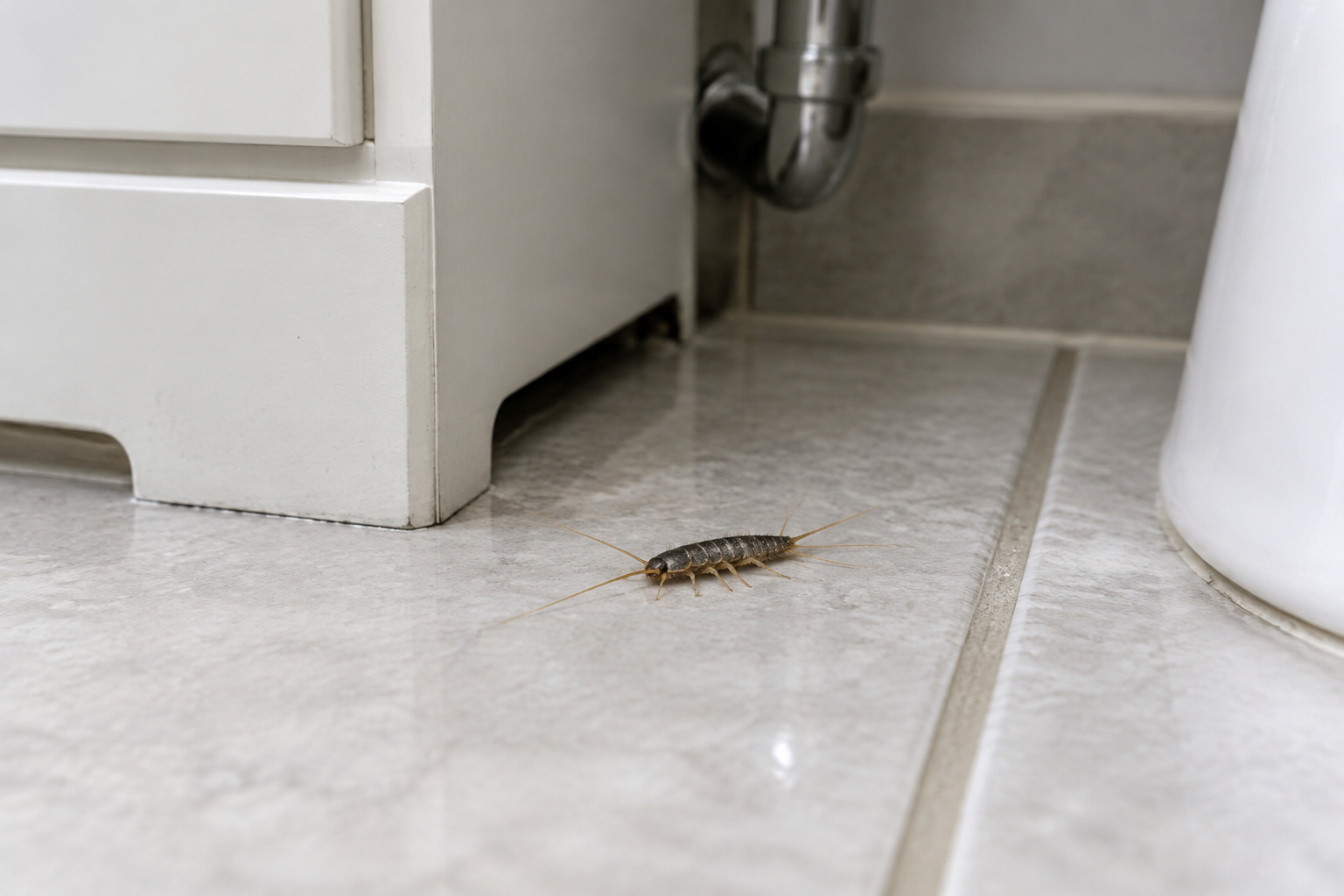
Silverfish in a bathroom usually find moisture, dark hiding places, and gaps around plumbing. A silverfish trapped in a sink or bathtub probably did not come through the drain. Remove or capture the insect, then inspect the room for leaks, condensation, damp storage, and concealed edges.
Quick answer: Vacuum or capture the insect, photograph it for identification, help the bathroom dry, remove damp paper and cardboard, and place sticky monitors along protected wall edges. One sighting usually doesn’t justify widespread pesticide use.
Make Sure It Is a Silverfish
Bathroom location alone cannot identify an insect. Look at its body before deciding how to respond.
A silverfish typically has:
- A flattened, wingless body that narrows toward the rear
- Silver, pearl-gray, or metallic-looking scales
- Two long antennae
- Three long, tail-like filaments
- Fast, darting movement when exposed
- A body roughly 1/4 to 1/2 inch long, depending on age and species
Capture the insect on a sticky monitor or take a clear close photograph if these features aren’t visible. Quick movement near a drain isn’t enough to confirm silverfish.
Firebrats are a common look-alike. They have the same tapered shape and three rear filaments, but they often appear mottled gray or brown. They are more closely associated with warm areas near heating equipment, hot pipes, and furnaces. Finding one in a bathroom doesn’t settle the difference.
Do Silverfish Come From Bathroom Drains?
Silverfish found in sinks and tubs generally haven’t traveled up the drain. They may enter the fixture while moving through the room, then become trapped because they cannot climb its smooth sides.
That means pouring cleaners or pesticides down the drain won’t address the likely source. The insect may have traveled from a baseboard gap, pipe opening, vanity, wall space, or adjoining room.
The bathroom can also be where you notice silverfish rather than where most activity occurs. Follow repeated sightings away from the fixture instead of treating the drain as the starting point.
Why Silverfish Appear in Bathrooms
Bathrooms can provide water, shelter, and undisturbed edges. Silverfish may use moisture from plumbing leaks, condensation, wet mats, or water escaping around a shower or tub.
They can hide under vanities, behind trim, around pipe openings, and inside cracks. Cardboard boxes, paper bags, magazines, wallpaper paste, and other starch-containing materials may also provide food or shelter.
Their presence doesn’t mean the bathroom is dirty. Even a clean room can have a concealed leak or an opening into a wall space.
Inspect the Bathroom in a Useful Order
Start near the sighting, then expand outward:
- Check the fixture. Look around the tub, shower, sink, and toilet for water that remains after normal use.
- Inspect the vanity. Examine supply lines, the sink trap, cabinet corners, and pipe openings for dripping or condensation.
- Follow the walls. Check baseboards, trim gaps, the vanity toe-kick, and the area behind the toilet.
- Review stored items. Remove damp cardboard, paper bags, magazines, and long-undisturbed paper goods.
- Check nearby spaces. Inspect the bathroom doorway, linen closet, adjoining room, and opposite side of shared walls.
Don’t cover an active leak with sealant. Repair the water problem first, and avoid sealing openings needed for ventilation or building drainage.
Dry, Clean, Store, and Seal
Help the room dry between uses. Run the existing exhaust fan or use available ventilation, allow wet mats and surfaces to dry, and arrange repairs for dripping pipes or failed bathroom seals. There is no single humidity setting or dehumidifier schedule that fits every home.
Vacuum along baseboards, beneath the vanity, behind the toilet, and inside dry cabinets. Removing dust, hair, dead insects, and debris makes these edges less useful to silverfish.
Move paper and cardboard out of damp storage. Keep items that must remain in the bathroom clean, dry, and inside closed containers.
After leaks are corrected, seal appropriate gaps along trim and around places where pipes enter walls or floors. Avoid opening walls or disturbing building materials you cannot assess safely.
Monitor for Continuing Activity
Place sticky insect monitors on dry, protected surfaces under the vanity, along walls, near pipe openings, and outside the bathroom doorway. Keep them out of reach of children and pets.
Write the date and location on each monitor, then inspect them regularly. The pattern matters more than any universal catch number. Repeated catches near one pipe opening suggest a different source than scattered catches across several rooms.
Monitoring also shows whether cleaning, repairs, and storage changes are reducing activity. It is more informative than repeatedly removing insects from the bathtub.
Be Careful With Pesticides
An occasional silverfish can often be managed without insecticides. Broad bathroom spraying and total-release foggers do not repair leaks, remove hiding places, or reveal insects moving inside walls.
If you consider a pesticide, first confirm the pest. Use only a product currently lawful in your area whose complete label lists silverfish and permits use in that exact indoor location. Follow every label direction concerning placement, exposure, protective equipment, cleanup, storage, disposal, and re-entry.
Never apply a pesticide to a sink, tub, shower, drain, or water source unless the current label specifically allows it.
When to Get Additional Help
Consider professional identification, pest management, or building repair when:
- You cannot distinguish the insect from a firebrat or another pest
- Monitors repeatedly catch insects in several rooms
- Sightings continue after accessible moisture and storage problems are corrected
- Activity appears to come from walls, fixed cabinets, or beneath flooring
- Books, photographs, wallpaper, or stored documents are being damaged
- A hidden leak or condensation problem needs specialized repair
- Plumbing and wall spaces connect multiple apartments or condominium units
Renters should document leaks, sightings, and monitor catches, then report needed repairs through the property’s maintenance process.
Check your monitors after making corrections. Follow recurring catches toward the nearest moisture source, storage area, or concealed opening rather than treating each visible insect as a separate problem.