

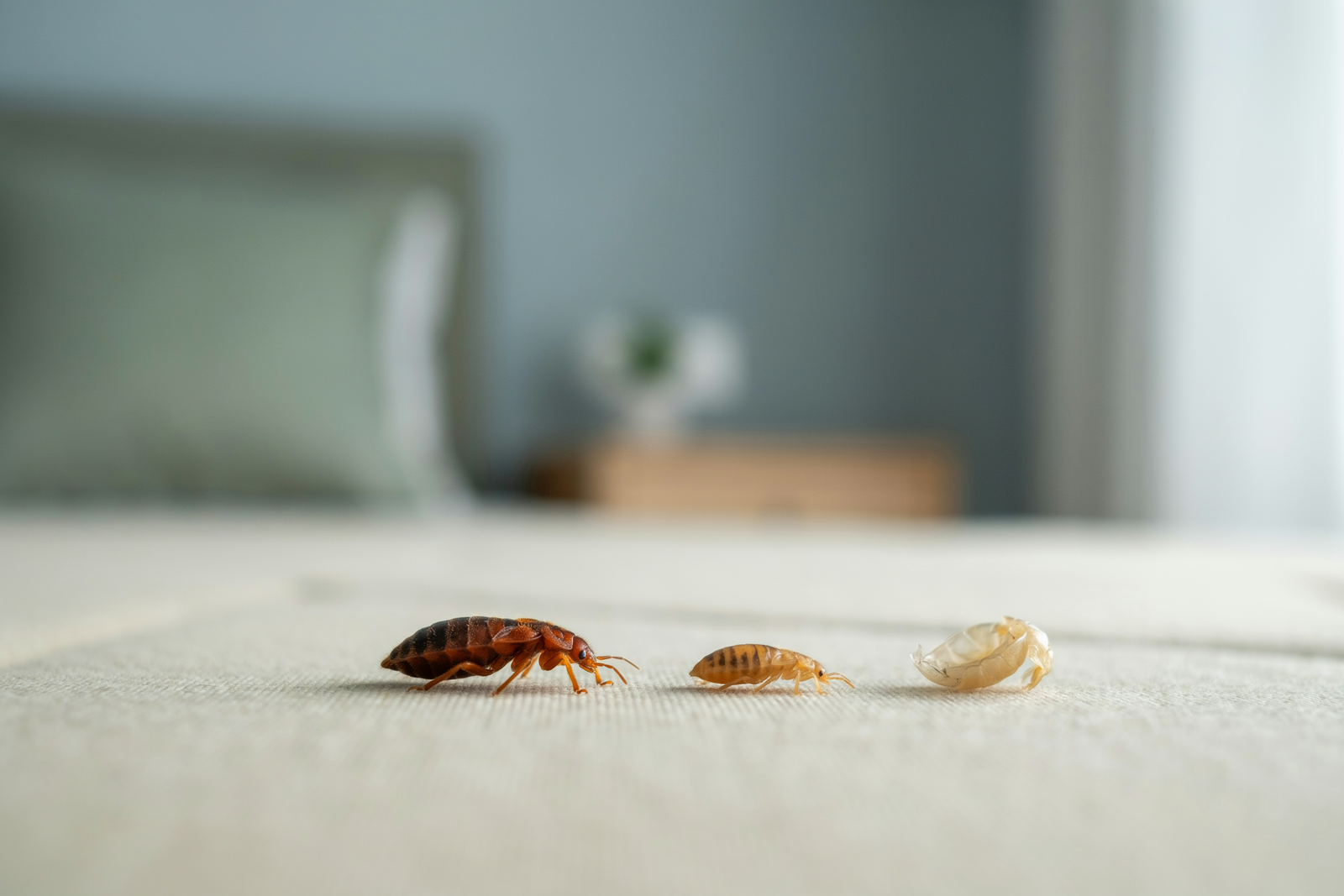
Bed bugs are flat, oval insects about the size of an apple seed when fully grown. Before comparing insects with bed bugs pictures, capture a clear sample if possible and inspect nearby seams for eggs, shed skins, or live bugs. Bites alone cannot confirm what pest you have.
Quick answer: Adult bed bugs are reddish-brown, wingless, and roughly 3/16 to 1/4 inch long. Young bed bugs are smaller and paler. Their tiny white eggs are usually attached inside cracks, seams, or other protected spaces.
What adult bed bugs look like
An unfed adult bed bug has a broad, oval body that is noticeably flattened from top to bottom. Its shape is sometimes compared with an apple seed, although the insect has six legs, two antennae, and visible body segments.
Look for these features:
- Color: Mahogany to reddish-brown
- Size: Usually about 3/16 to 1/4 inch long
- Shape: Broad, oval, and flat when unfed
- Wings: No functional wings
- Legs: Six, extending from the front half of the body
- Movement: Crawls rather than jumps or flies
After feeding, the body becomes longer, rounder, and more red or dark brown. That change can make the same insect look quite different in separate photographs.
Bed bugs are visible without magnification, but a flashlight and magnifying glass can make their features easier to examine. Phone cameras may distort size, so place the insect beside a ruler or coin when taking identification photos.
What bed bug nymphs look like
Young bed bugs, called nymphs, have the same general shape as adults but are smaller and lighter. Newly hatched nymphs can be about 1/16 inch long and nearly colorless or pale yellow.
A nymph that has recently fed may show a bright or dark red area through its partly transparent body. As it develops through five immature stages, it becomes larger and progressively darker.
Because unfed young nymphs blend into pale fabric and wood, look for movement along mattress piping and inside narrow seams. Good lighting matters more than relying on color alone.
What bed bug eggs and shed skins look like
Bed bug eggs are pearly white, about the size of a pinhead, and roughly 1 millimeter long. They are oval rather than perfectly round and may have a small cap at one end.
Fresh eggs are coated with a sticky substance that helps them remain attached to a surface. You may find individual eggs or small groups in protected areas, but lint and fabric fibers can look similar without magnification.
Nymphs shed their outer covering as they grow. These shed skins are:
- Pale yellow or translucent
- Hollow and shaped like a bed bug
- More structured than ordinary flakes or crumbs
- Often found near mattress seams, bed-frame joints, and hiding places
Eggs or shed skins strengthen the case for bed bugs, especially when found with a live insect. A single pale speck is not enough for a confident identification.
Where to inspect before comparing bed bugs pictures
Start close to where people sleep or rest. Bed bugs usually hide in tight spaces where their bodies touch a surface above and below.
Use a flashlight to check:
- Mattress piping, labels, seams, and tufts
- Box-spring edges, fabric folds, and the underside
- Headboard and bed-frame joints, screw holes, and cracks
- Baseboards and gaps beside the bed
- Seams and undersides of upholstered chairs or sofas used for sleeping
- Nearby furniture joints and drawer corners
Look for more than one kind of evidence. Live bugs, attached eggs, shed skins, and dark spotting near hiding places are more useful together than any single sign. Dark spots may be bed bug waste, but stains alone can have other causes.
Avoid moving bedding or furniture into another room while you investigate. Transporting belongings can spread hidden insects. Don’t discard a mattress based only on a suspected bite or unclear photograph.
Common bed bug lookalikes
Several small household pests are regularly mistaken for bed bugs. Shape, location, and behavior help separate them.
- Carpet beetles: Adult carpet beetles are more rounded and often mottled with white, brown, or yellow scales. Their larvae are elongated and visibly hairy. Bed bugs are not hairy like carpet beetle larvae.
- Fleas: Fleas are narrow when viewed from above, have enlarged hind legs, and can jump. Bed bugs are broader, flatter from top to bottom, and cannot jump.
- Ticks: Ticks have eight legs as nymphs and adults and lack antennae. Bed bugs are insects with six legs and two antennae.
- Booklice: These very small insects are usually pale, soft-bodied, and associated with damp areas or mold. Their heads look proportionally larger than a bed bug’s.
- Cockroach nymphs: Young cockroaches have longer antennae, a more elongated body, and two small projections at the rear. They often move much faster than bed bugs.
- Bat bugs: Bat bugs closely resemble bed bugs and may require magnification or expert examination to separate. Their longer body hairs are a key difference. Finding them near an attic, chimney, or bat roost is an important clue, but wildlife issues should be handled under local rules.
- Spider beetles: These pantry pests have rounded, shiny bodies and long legs. They look more globe-shaped than the broad, flattened bed bug.
An insect’s location is helpful but not conclusive. Carpet beetles and cockroach nymphs can wander into bedrooms, while bed bugs may hide in living-room furniture.
Save a specimen for identification
If you find a suspected bed bug, collect it without crushing it. Use clear tape or place it in a sealed, rigid container. Note exactly where and when you found it, then take sharply focused photographs from above.
A local cooperative extension office, public health agency, landlord’s pest professional, or licensed pest-control firm may be able to examine the specimen. Expert confirmation is especially useful for pale nymphs, damaged insects, and possible bat bugs.
Until the pest is confirmed, avoid foggers, homemade mixtures, and broad pesticide spraying. These approaches can expose people and pets unnecessarily, and they may scatter bed bugs into harder-to-reach places. If treatment becomes necessary, use only products labeled for bed bugs and the intended indoor location, following the complete current label.
When an inspection should move beyond DIY
Arrange a professional inspection when you repeatedly find likely bed bug evidence, cannot reach suspected hiding places, or live in a multi-unit building where insects may move between homes. Notify the landlord or property manager promptly if your lease or local rules require it.
Professional help is also sensible when identification remains uncertain after you collect a specimen. Correct identification comes before treatment because bed bugs, bat bugs, fleas, and carpet beetles require different responses.
Your next step is simple: inspect the bed and nearby furniture, preserve any insect you find, and seek specimen-based confirmation before treating the room.
