
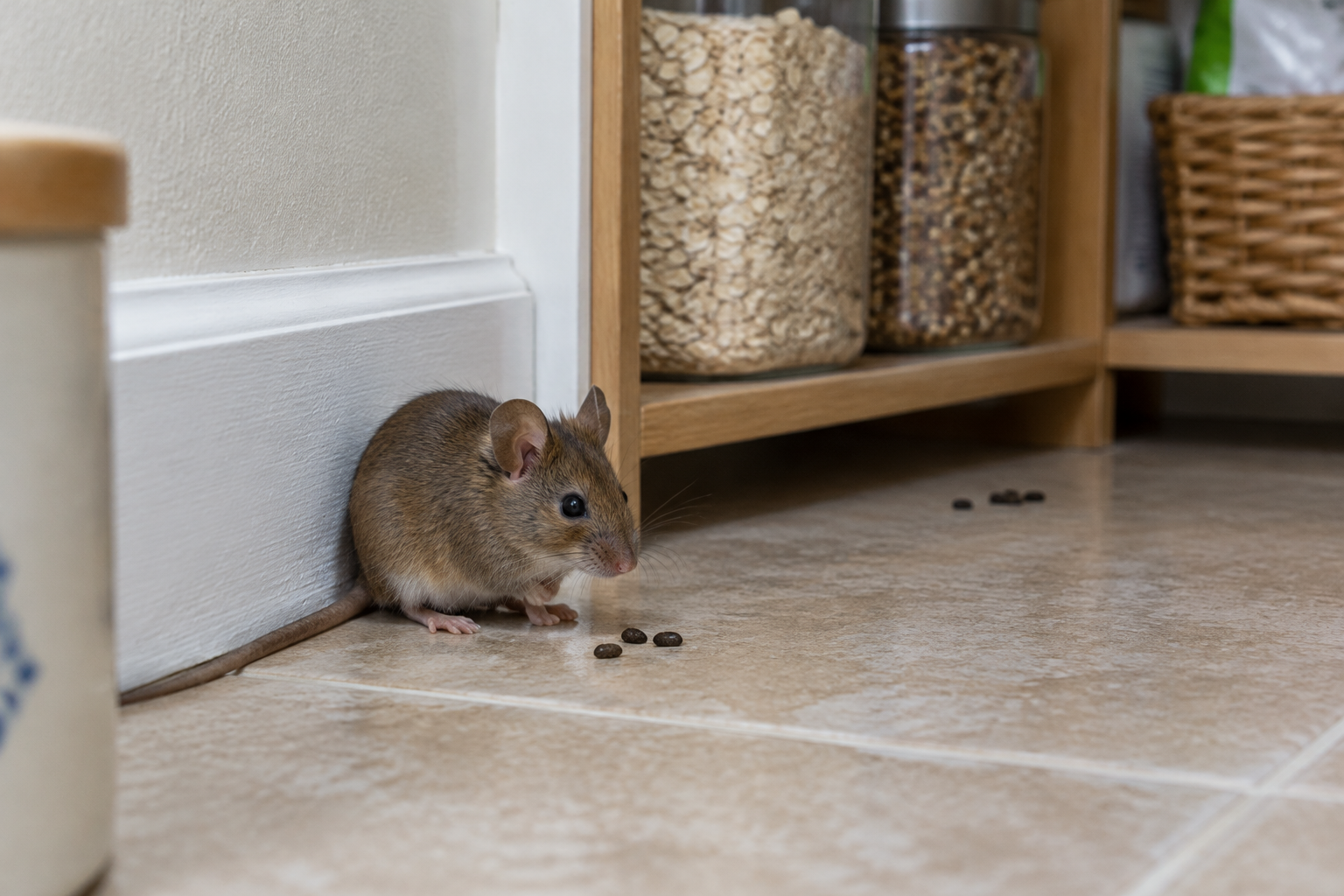
The main difference between rat droppings and mouse droppings is usually overall size. Mouse pellets tend to be smaller and narrower, while rat pellets are larger and thicker. Don’t sweep, brush, or vacuum dry droppings while inspecting them. Their appearance can guide your next step, but droppings alone cannot confirm the species.
Rat Droppings vs Mouse Droppings at a Glance
Compare several intact pellets with a ruler rather than judging one damaged piece. Avoid picking them up or breaking them apart.
- Mouse droppings: Usually about 1/8 to 1/4 inch long. They are relatively narrow, smooth, and shaped somewhat like grains of rice. One or both ends may look pointed.
- Rat droppings: Commonly about 1/2 to 3/4 inch long and noticeably wider. Some Norway rat droppings may approach 1 inch.
- Norway rat droppings: Often cylindrical or capsule-shaped, with ends that appear rounded or blunt.
- Roof rat droppings: Often narrower than Norway rat droppings and may have tapered or pointed ends.
Size and width are generally more useful than end shape. The common rule that pointed pellets mean mice and blunt pellets mean rats is incomplete. Roof rat droppings can be pointed, while pellets from individual animals can vary with age, size, and diet.
Color is also a weak clue. Rodent droppings are often dark, but color changes with diet, age, moisture, and surrounding conditions. Shine, softness, or dryness cannot reliably tell you exactly when a pellet was deposited.
Why Droppings Don’t Prove the Species
Treat your comparison as “more consistent with a mouse” or “more consistent with a rat,” not a final identification. A crushed pellet may look smaller than it was, and other household pests can leave similar material.
Cockroach droppings, for example, may be mistaken for small rodent pellets. Some cockroach pellets have visible lengthwise ridges, while rodent droppings are generally smooth. Bat and other wildlife droppings require a different identification and cleanup context.
Location doesn’t settle the question either. Both mice and rats may visit kitchens, cabinets, garages, attics, and storage areas. Pellet count also won’t reveal exactly how many rodents are present because you may be seeing waste accumulated over an unknown period.
Check the Evidence Around the Pellets
Improve your identification by looking for several signs that point in the same direction. Photograph the group from a safe distance with a ruler or coin nearby for scale. Record where you found it without disturbing the material.
Look for:
- Gnawed food packages or damaged stored items
- Fine or heavy tooth marks on wood and other materials
- Shredded paper, fabric, or insulation used for nesting
- Tracks in dusty areas
- Greasy rub marks along walls or repeated travel routes
- Burrows or likely entry openings
- Direct sightings or camera footage
Larger tracks, broad gnaw marks, noticeable rub marks, and burrows strengthen the case for rats. Very small access gaps and finer damage may support mice. Even then, a clear sighting, capture, or professional inspection provides stronger evidence than droppings alone.
How to Clean a Limited Area Safely
For a small, accessible area, follow current public-health cleanup guidance rather than removing dry waste with ordinary housekeeping methods.
- Keep people and pets away. Do not sweep or vacuum the droppings, urine, or nesting material while dry.
- Ventilate an enclosed space when appropriate. If you’re entering a closed shed, cabin, or outbuilding, air it out for 30 minutes before cleaning and leave during that period.
- Wear rubber or plastic gloves. Avoid touching your face or handling clean household objects during the cleanup.
- Wet the contamination thoroughly. Use a household product labeled as a disinfectant and follow its complete directions. Leave the area wet for the label’s required contact time.
- Wipe up the material. Use paper towels, then place the waste in the appropriate covered trash container under local disposal rules.
- Disinfect the surrounding hard surface. Follow the product label, and never mix disinfectants or other cleaners.
- Wash carefully. Wash gloved hands before removing the gloves. Then wash your bare hands with soap and water.
These steps apply to limited household contamination. They are not a substitute for the additional precautions needed in a heavily contaminated building, insulation, ductwork, or another difficult space.
When Professional Help Is the Better Next Step
Get qualified help when droppings are widespread, densely accumulated, or mixed with extensive urine and nesting material. Heavy contamination can require respiratory protection and procedures beyond ordinary household cleanup.
Professional assessment is also appropriate when:
- Waste is inside HVAC ducts, wall spaces, or heavily soiled insulation
- Evidence suggests rats, but the species or nesting area remains uncertain
- Activity involves wiring, appliances, plumbing, or structural materials
- You cannot place traps away from children, pets, or other animals
- New droppings continue after cleanup and reasonable prevention
- The material could be from bats or other wildlife
Renters should notify the property owner or manager when repairs or coordinated building-wide control are needed. If you develop an illness that you think may relate to rodent exposure, contact a healthcare professional and mention the exposure rather than trying to diagnose it yourself.
Clean, Record, and Monitor
After cleanup, remove accessible food and water, secure trash, store pet food in closed containers, and repair visible gaps you can reach safely. Record the cleanup date and location.
Check the area regularly without disturbing new material. Fresh droppings appearing in a cleaned space are much stronger evidence of current activity than an undated pile. That record, along with photographs and measurements, will also make later identification or professional inspection more useful.