

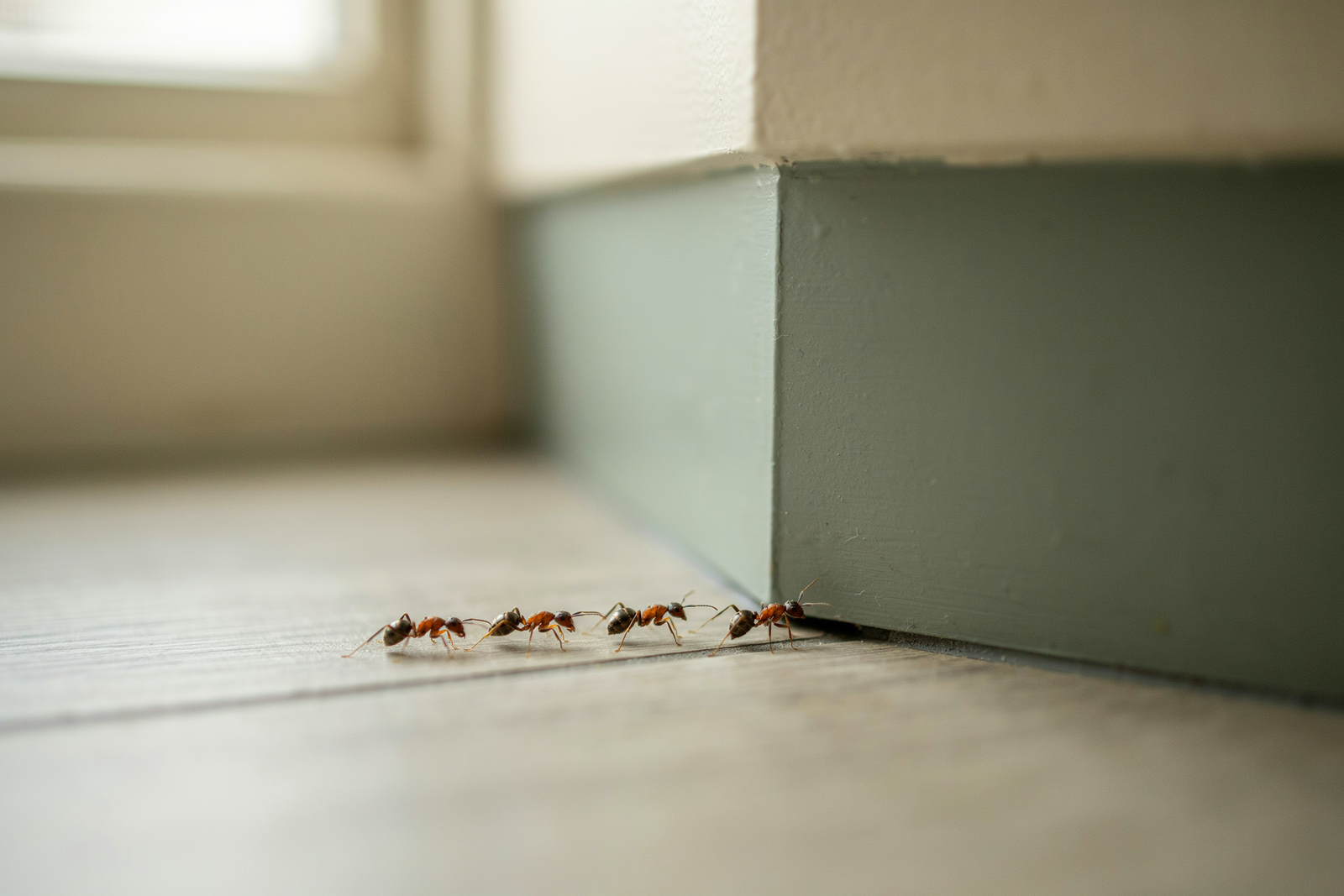
To get rid of ants in the house, clean up what attracts them, trace their trail, and seal entry points after activity declines. If ants keep returning, a bait labeled for indoor use may reach the colony more effectively than spraying visible workers. Identification matters because some ants nest inside damp or damaged wood and require a different response.
Quick answer: Wipe up food and spills, store food in sealed containers, fix moisture problems, and follow the ant trail toward its source. Avoid spraying along an active trail if you plan to use bait. Place any pesticide only where its label permits, away from children, pets, and food.
Start by following the ant trail
Watch the ants before cleaning the trail away. Their route can reveal where they enter, what attracts them, or where a nest may be hidden.
Check common trouble spots:
- Along baseboards and cabinet edges
- Around windows, doors, and utility lines
- Beneath sinks and near leaking pipes
- Behind appliances
- Around pet-feeding areas
- Near pantry shelves, trash, and recycling
- Around damp wood or water-damaged walls
Note the ants’ approximate size, color, and behavior. A clear close-up photograph or a captured specimen in a sealed container may help an extension office or pest professional identify them. Color alone is rarely enough.
Large ants repeatedly emerging near damp wood may be carpenter ants. They excavate wood for nesting but do not eat it. Because their presence can point to a moisture problem or a nest inside the building, repeated indoor activity deserves closer inspection.
Remove the food and water they are using
Ant control works better when alternative food and water are scarce. This also makes bait more attractive if you later need it.
Take these practical steps:
- Clean crumbs, grease, and sweet spills. Pay attention to stove edges, toaster areas, cabinet corners, and spaces beneath appliances.
- Store food in tightly closed containers. Include sugar, snacks, baking supplies, and pet food.
- Rinse recycling and empty trash regularly. Clean residue from the bin and surrounding floor.
- Limit pet food between meals. Wash bowls and wipe the feeding area, while following your pet’s feeding needs.
- Correct moisture sources. Repair accessible leaks, dry sink areas, and replace water-damaged material when appropriate.
Use ordinary soap and water to wipe the indoor trail after observing where it leads. Cleaning removes food residue and the scent trail that helps other workers follow the same route.
Seal entrances after activity slows
Once you know where ants are entering, close small openings that can be repaired safely. Seal gaps around window and door frames, baseboards, pipes, cables, and other wall openings with a material suitable for that surface.
Replace damaged door sweeps and repair screens where ants are entering. Trim vegetation that touches the building when it can be reached safely, since branches can provide a route indoors.
Don’t seal a suspected indoor nest into a wall without understanding the situation. If ants continue emerging from an inaccessible void, identification and targeted treatment may be necessary.
How to get rid of ants in the house with bait
Ant bait combines food with a pesticide that works slowly enough for foraging ants to carry it toward the colony. It can be useful when sanitation and exclusion do not stop an established trail.
Choose only a product whose current label lists the ant and the indoor location where you intend to use it. Read the entire label before placement. Follow its directions for positioning, monitoring, replacement, storage, and disposal.
For safer and more effective use:
- Place bait near active trails only where the label allows.
- Keep it inaccessible to children and pets.
- Keep pesticides away from food and food-preparation surfaces.
- Don’t spray insecticide or strong cleaners around the bait.
- Don’t combine products or apply more than the label directs.
- Remove bait as directed when activity ends or the product is no longer needed.
Ant food preferences can vary by species, season, and colony needs. A bait may be ignored even when it is correctly placed. If ants do not feed on it, reassess the location and identification rather than adding more pesticide.
Activity may briefly remain visible because workers must find and carry the bait. Judge progress by whether the number of ants declines over time, following the product label’s expectations rather than assuming one day of activity means failure.
What not to do
Avoid relying on repeated spraying of visible ants. It may kill the workers you see without reaching the nest, and it can interfere with baiting. Some ant species may also spread into additional nesting sites when disturbed by certain treatments.
Don’t make pesticide mixtures from household ingredients or use outdoor, agricultural, or unlabeled products indoors. Products described as natural can still harm people, pets, or surfaces when misused.
Never pour pesticides, fuel, or boiling water into walls, electrical areas, or unknown nest openings. These approaches can cause exposure, fire, burns, or property damage without resolving the colony.
Monitor for returning ants
Check the original trail and nearby food or water sources every few days. Record where ants appear and whether their numbers are rising or falling. This helps distinguish an occasional outdoor visitor from continuing indoor nesting.
If activity stops, keep food storage, moisture control, and exclusion measures in place. New ants may arrive through a different opening, so another trail does not necessarily mean the earlier treatment failed.
When to call a pest professional
Professional help is the safer next step when:
- Ants keep returning despite sanitation, exclusion, and correctly used bait.
- Several rooms or apartment units have continuing activity.
- Ants appear to be nesting inside walls, ceilings, or other places you cannot reach.
- Large ants repeatedly emerge from damp or damaged wood.
- You cannot identify the ants well enough to select an appropriate control.
- Pesticide use would be difficult to manage around children, pets, pregnancy, asthma, or food areas.
In a rental or multi-unit building, report persistent activity and leaks to the property manager. Ants can travel between connected units, so treating one room may not address the source.
If anyone may have swallowed or been exposed to a pesticide, follow the product label’s first-aid directions and contact the appropriate poison-control or emergency service. Otherwise, your next step is simple: observe one active trail, remove its food or water source, and use what you learn to choose between sealing, targeted bait, or professional inspection.
