

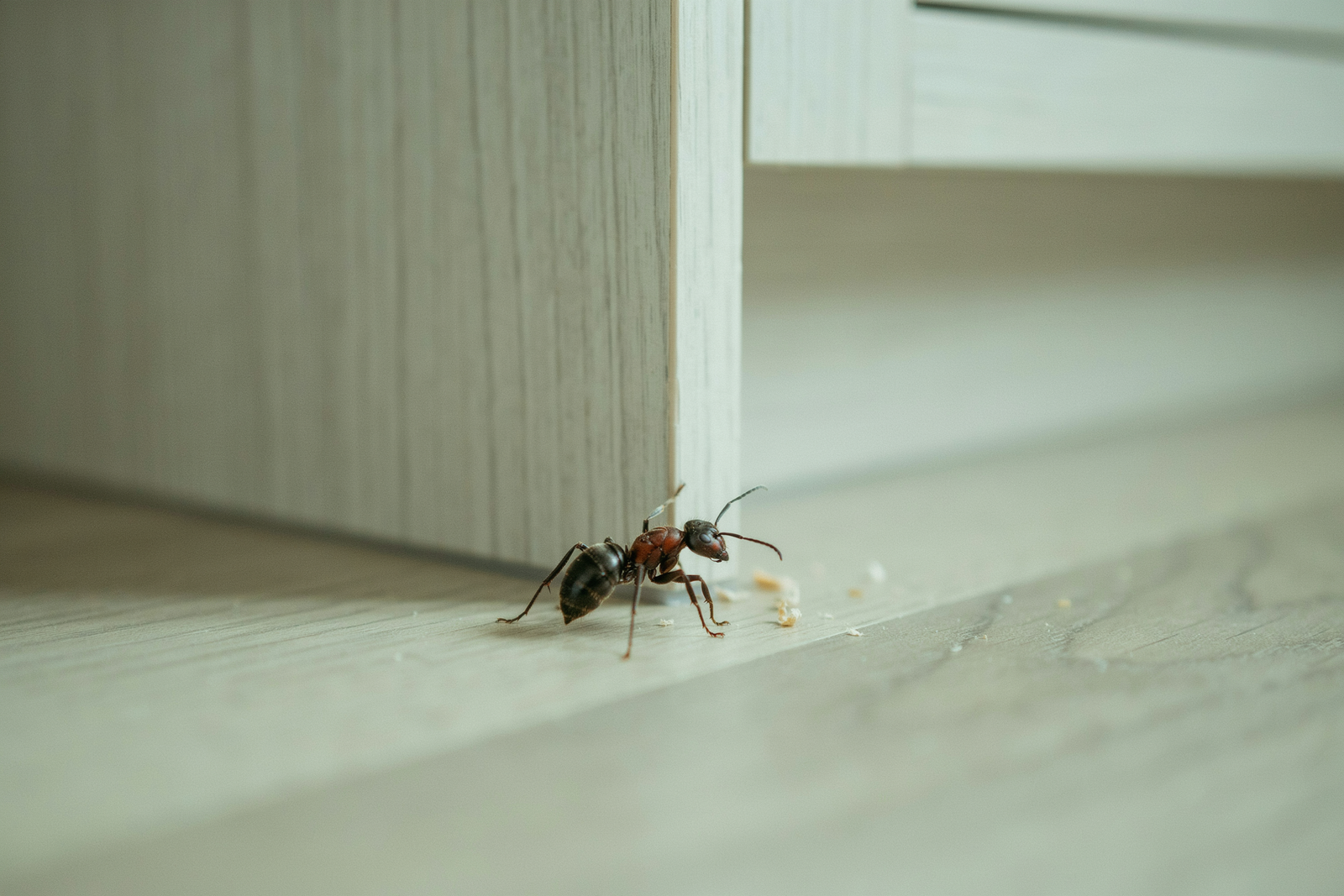
To get rid of carpenter ants in the kitchen, document and trace their route, repair leaks or damp wood, remove accessible food and water, and use only a targeted control labeled for confirmed carpenter ants. Vacuuming or wiping up visible workers provides temporary relief, but it will not eliminate a nest hidden in a wall, cabinet, or another part of the property.
Quick answer: Check under the sink and around the dishwasher for moisture, note where the ants emerge, clean up food and standing water, and monitor the same area after dark. Arrange an inspection if the trail leads into the structure or moisture-damaged wood is present.
What to Do Right Now
Record the ants’ route before cleaning everything away. Photograph the insects and any debris, note the time they appear, and mark the crack, pipe opening, or cabinet edge from which they emerge.
Remove exposed food and water next. Seal pantry goods, clean sugar and grease residue, rinse recyclables, empty food waste, put away pet food, and dry the sink and counters overnight.
Vacuum the ants or wipe the trail with soapy water after documenting it. This removes current foragers and their scent trail, but more workers may appear if a colony or active route remains.
Confirm That Carpenter Ants Are Likely
Do not identify carpenter ants by size or color alone. Workers from the same colony can vary in size, and different species may be black, reddish brown, or a combination of colors.
Evidence that supports identification includes:
- A narrow waist and elbowed antennae
- One waist node and a smoothly rounded upper thorax
- Workers of noticeably different sizes using the same route
- Coarse sawdust-like debris, sometimes mixed with insect fragments
- Repeated nighttime activity from one opening
- Numerous winged ants appearing indoors
Carpenter ants excavate wood to create galleries, but they do not eat it. Sawdust-like material may indicate excavation, although construction debris, wood-boring insects, and termites can produce material that looks similar.
If you find a winged insect, remember that carpenter ants have elbowed antennae, narrow waists, and hind wings shorter than their front wings. Winged termites generally have straight antennae, broad waists, and wings of approximately equal length. Obtain a professional or Cooperative Extension identification if the distinction is unclear.
Where to Look for Carpenter Ants in the Kitchen
Start with moisture-prone areas because parent nests are often associated with damp or decayed wood. Satellite nests can occupy dry wall voids, insulation, hollow spaces, or sound wood, so the absence of visible moisture does not rule them out.
Inspect these locations without opening walls or dismantling cabinets:
- Sink supply lines, shutoff valves, drains, and the cabinet base
- Dishwasher connections and adjacent cabinets or flooring
- Refrigerator water and ice-maker lines
- Pipe and wire penetrations through walls
- Swollen cabinet panels, stained trim, or lifted flooring
- Window and exterior-door framing
- Backsplash, baseboard, and countertop gaps
- The exterior wall corresponding to the indoor activity
Look for drips, condensation, soft trim, staining, swollen material, or a persistent damp area. Repair active leaks promptly and arrange appropriate building repairs if wood or flooring remains wet.
Follow active trails with a flashlight after dark when practical, since carpenter ants often forage in the evening or at night. Do not move hardwired appliances, probe electrical spaces, or enter inaccessible areas to continue a trail.
Monitor Before Sealing the Route
Find out where the ants are traveling before sealing a visible gap. A few kitchen ants could be outdoor foragers entering for food, while recurring ants from a wall void may indicate an indoor satellite or parent nest.
Keep a simple log for several nights that records:
- Date and time
- Approximate number of ants
- Emergence point and direction of travel
- Whether debris has returned
- Whether activity changed after cleaning and leak repair
Inspect the corresponding exterior area for utility openings, damp trim, decaying wood, stumps, stored firewood, or branches touching the building. Seal appropriate exterior gaps after you understand the route, but do not rely on caulk to eliminate an established colony.
Use Bait or Pesticides Only as Labeled
If you consider bait, confirm that the current label specifically includes carpenter ants and permits indoor residential use in the intended kitchen location. Some general ant products exclude carpenter ants, and carpenter ants may ignore a bait as their food preferences change.
Follow every label restriction covering placement, food areas, children, pets, storage, cleanup, and disposal. Keep bait inaccessible to children and pets and away from food-contact surfaces unless the label expressly allows otherwise.
Do not place pesticides in homemade containers or use improvised borax, essential-oil, bleach, or vinegar mixtures. Avoid spraying workers near bait because contamination or repellency may interfere with feeding. Lack of bait feeding does not prove the colony is gone.
When to Call a Professional
Arrange a licensed pest inspection when ants repeatedly emerge from a wall, ceiling, floor, built-in cabinet, or electrical area. Professional help is also appropriate when:
- Coarse debris repeatedly accumulates from one opening
- Numerous winged ants appear indoors
- More than one trail or suspected nest is present
- Wood is soft, swollen, stained, or visibly damaged
- Activity continues after food, water, and moisture conditions are corrected
- Treatment would require drilling or opening a structural cavity
- You cannot distinguish the insects or debris from possible termite evidence
If you rent, document the ants, debris, and moisture conditions, then notify the landlord or property manager according to your lease and local requirements.
Inspect the under-sink cabinet and dishwasher area for moisture tonight, record where the ants emerge, and arrange professional inspection if their route disappears into the structure.
