
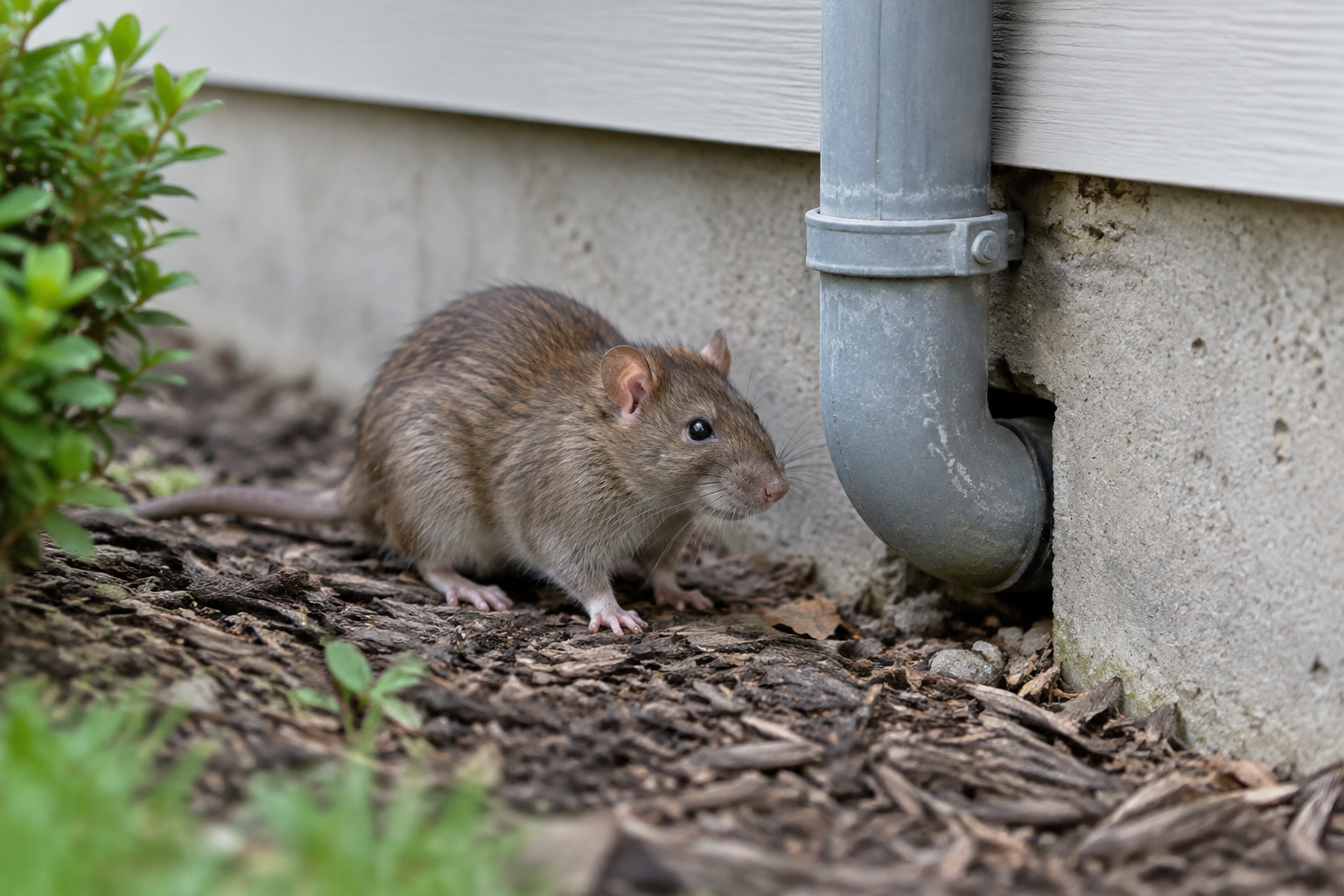
How do rats get in the house? They usually use an existing opening or gnaw at a weak edge until it becomes large enough. Start with a daylight inspection from ground level, but don’t permanently seal the last suspected active opening if rats may still be inside walls, ceilings, or other enclosed spaces.
Quick answer: Check exterior doors, garage corners, foundations, vents, utility pipes, drains, siding joints, and attached structures. Also inspect upper openings from the ground because rats can climb to eaves, soffits, and attic vents.
Follow the exterior perimeter first
Walk slowly around the house and inspect where different materials or parts of the building meet. Rats often exploit construction gaps, damage, or repairs made with materials they can gnaw.
Concentrate on these accessible locations:
- Exterior doors: Look for daylight under closed doors, worn sweeps, damaged thresholds, and gaps at the corners.
- Garage doors: Check both lower corners and the seal between an attached garage and the living area.
- Foundation edges: Inspect cracks, missing mortar, damaged vent covers, and gaps where siding meets masonry.
- Pipes and utility lines: Look around water pipes, air-conditioning lines, cables, and other services entering the wall.
- Vents and screens: Check for torn mesh, bent covers, loose frames, or gnawed edges.
- Siding and trim: Inspect loose panels, rotted wood, and open joints near the foundation.
- Attached structures: Pay close attention where a porch, deck, addition, or attached garage joins the house.
- Drains: Damaged floor drains or drain connections can provide access, although sewer entry isn’t the usual explanation in most homes.
Don’t rely on one universal hole size. Rats may use openings around half an inch, while young rodents and mice can use smaller gaps. Rodents can also enlarge soft or damaged edges. Repair visible gaps larger than about one-quarter inch when practical, especially if nearby evidence suggests repeated activity.
Remember that rats can enter above ground
Some rats climb shrubs, vines, fences, drainpipes, rough walls, and nearby branches. These routes may lead to openings at eaves, soffits, attic vents, or roof-to-wall joints.
Inspect upper areas from the ground or through a safely accessible window. Don’t climb onto a roof, use an unstable ladder, approach overhead service lines, or dismantle elevated vents. If you see damage beyond safe reach, photograph the location and arrange an appropriate inspection.
Trim vegetation that touches the building where you can do so safely. A branch or vine doesn’t prove where rats entered, but removing these bridges can reduce access to upper openings.
Match outdoor gaps with indoor evidence
Check the indoor side of each suspicious exterior location. Useful places include beneath sinks, inside lower cabinets, behind safely movable appliances, around laundry and water-heater connections, and along wall-to-floor edges.
An opening becomes more relevant when several signs line up, such as:
- fresh gnawing around its edges
- greasy rub marks along a repeated route
- tracks in dust
- droppings nearby
- damaged food packages or nesting material
- repeated noises or a clear camera image in the same area
These signs support rodent activity but don’t identify a rat with certainty. Mice and juvenile rats can leave overlapping evidence. A hole near droppings may also be part of a travel route rather than the actual entrance.
If you encounter droppings or nesting material, don’t sweep or vacuum it dry. Avoid disturbing it during the inspection and follow current public-health guidance for wet cleanup. Widespread contamination requires additional precautions.
Use repairs that resist gnawing
Choose durable materials suited to the opening. Metal mesh or hardware cloth, sheet metal, flashing, and cement-based repairs are generally more resistant than soft filler.
Foam, caulk, plastic, or wood alone may fail where a rodent can reach and gnaw an exposed edge. These products may form part of a supported repair, but they shouldn’t be treated as a rat-proof barrier by themselves.
For doors, correct the fit and install a suitable threshold or sweep rather than stuffing the gap temporarily. Replace torn screens and damaged vent covers while preserving the ventilation or drainage the opening was designed to provide.
Seal rat entry points in the right order
Document suspected openings before changing them. Take photos, note nearby signs, and reduce food and water sources by securing garbage, storing food and pet food in sturdy containers, cleaning spills, and removing pet bowls overnight.
Next, determine whether rodents may remain inside. Permanently closing the final active route can trap animals in walls, ceilings, attics, or enclosed rooms. If you cannot account for the indoor activity from reachable areas, have a licensed pest professional coordinate removal and exclusion.
Once the indoor population has been addressed, complete durable exterior repairs. Then monitor the same locations for fresh droppings, renewed gnawing, noises, tracks, or displaced repair material.
When the entry route needs professional inspection
Arrange help when the suspected opening involves a roof, chimney, high soffit, unsafe crawl space, electrical service, damaged sewer line, foundation defect, or concealed wall space. Professional assessment is also appropriate when activity continues after accessible gaps and food sources have been addressed.
Other reasons to escalate include widespread droppings, persistent odor, several possible routes, recurring entry after repairs, or uncertainty about whether the animal is a rat, mouse, squirrel, bat, or another species. Renters should document the evidence and contact the landlord or property manager when repairs involve the building exterior or shared areas.
For a minor, inactive-looking gap within safe reach, photograph it, make a durable repair, and monitor it closely. If you cannot tell whether rats remain inside, stop before the final seal and arrange an inspection instead.