
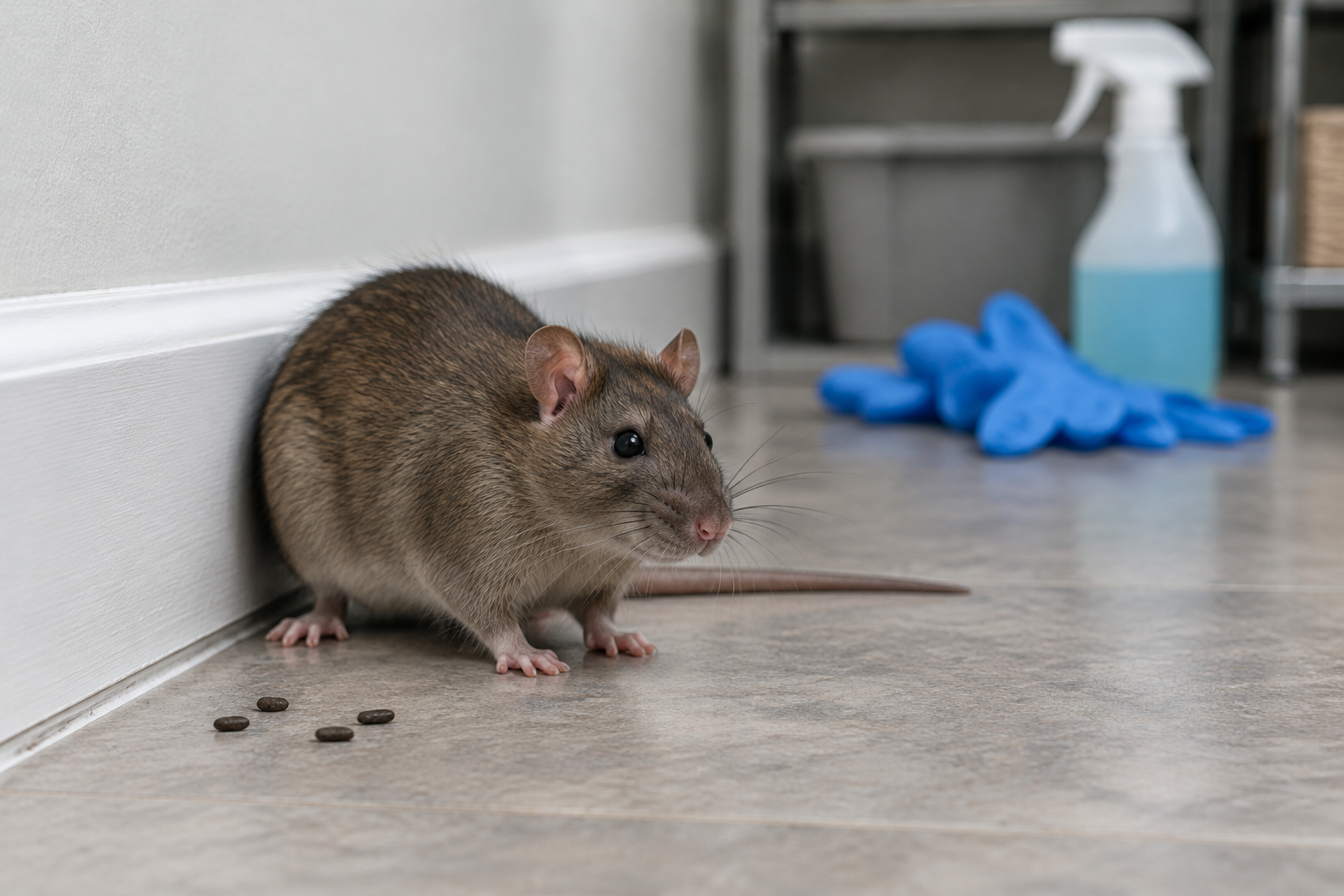
If you need to know how to clean up rat droppings, start by leaving them undisturbed. Don’t sweep, vacuum, or dry-dust the area because that can send contaminated particles into the air. A small amount in an accessible place can usually be wet-cleaned, but piles of waste, widespread contamination, or rodents in ventilation equipment require qualified help.
Quick answer: Keep people and pets away, ventilate the space, wear gloves, soak the waste with disinfectant, wait the required contact time, wipe it up, disinfect the surface, and wash your hands.
First, decide whether DIY cleanup is reasonable
The wet-cleaning method below is intended for a small, scattered amount of contamination in one accessible area. Examples include several droppings in a cabinet, garage corner, shed, or under-sink space.
Stop and seek professional guidance if you find:
- Piles of droppings, numerous nests, or several dead rodents
- Contamination spread through multiple rooms or a large outbuilding
- Waste in an attic, crawl space, wall, or other difficult area
- Contaminated exposed insulation
- Evidence of rodents inside ducts, an air handler, or other HVAC equipment
- A cleanup requiring demolition, extensive material removal, work at height, or entry into a confined space
Droppings alone may not confirm whether the animal was a rat, mouse, or another species. They also don’t prove that disease is present. The same cautious wet-cleaning approach is appropriate for a small amount of suspected wild-rodent waste.
How to clean up rat droppings and urine
1. Clear and ventilate the area
Keep children, other adults, and pets out. Open exterior doors and windows for 30 minutes, then leave while the room airs out. Don’t move boxes or disturb contaminated material during that time.
2. Put on gloves
Wear rubber or plastic gloves. Check the disinfectant label for any additional protective equipment and ventilation instructions.
3. Choose a disinfectant
Use a general-purpose household product whose label identifies it as a disinfectant. Follow its complete directions, including the surfaces where it may be used.
Alternatively, current CDC guidance allows a fresh solution of 1.5 cups of household bleach in one gallon of water, which is one part bleach to nine parts water. Provide good ventilation, and never mix bleach or any disinfectant with another cleaner.
4. Soak the contamination
Spray the droppings and urine until they are thoroughly wet. Keep the area wet for five minutes, unless the disinfectant label specifies a different contact time.
Don’t scrub, brush, or break apart dry material before wetting it.
5. Pick up and disinfect
Use paper towels to lift the wet droppings and other material. Put the used towels into a covered garbage container that is emptied regularly.
Wipe or mop the surrounding hard surface with disinfectant. Before removing your gloves, wash the gloved hands with soap and water or disinfect them. Remove the gloves, then wash your bare hands with soap and warm water.
Cleaning up a dead rat or nest
Wet the dead rodent, nest, trap, and surrounding surface with disinfectant. Wait five minutes or use the contact time on the product label.
Place the rodent, nest, disposable trap, and cleanup waste in a plastic bag and seal it. Put that bag inside a second plastic bag, seal it, and place it in a covered garbage container. State or local disposal rules may require a different method, so check locally if you’re unsure.
Don’t handle a live rat. If one cannot be controlled without risking a bite, keep people and pets away and contact a pest professional.
Handle contaminated materials carefully
Different materials need different treatment after solid waste has been removed safely:
- Hard, nonporous surfaces: Wipe or mop them with a disinfectant suitable for that surface.
- Cardboard: Discard contaminated boxes rather than trying to disinfect them.
- Washable fabrics: Launder them with hot water and detergent, then machine-dry on high or dry in sunlight.
- Carpets and upholstery: Shampoo or steam-clean them after safely removing solid contamination.
- Exposed insulation: Avoid disturbing it. Significant contamination or removal is a reason to obtain professional help.
Never spray bleach, ordinary household disinfectant, ozone, or another homemade treatment into ducts. Products labeled for household surfaces aren’t automatically approved for HVAC interiors.
Check whether rodents are still active
Once the area is clean, watch for new droppings, fresh gnawing, disturbed food packages, nesting material, sightings, or repeated trap activity. New evidence indicates that cleanup alone hasn’t resolved the rodent problem.
Store food and pet food in rodent-resistant containers. Remove accessible garbage, clean spills, correct leaks, and reduce clutter. Inspect around doors, pipes, vents, cabinets, garages, and foundations for possible entry points. Coordinate sealing with trapping or professional control if rodents may still be inside.
Renters should report recurring activity, building entry points, or inaccessible contamination to the property owner or manager.
Professional assessment is the safer next step when contamination is heavy, keeps returning, involves insulation or ventilation equipment, or requires respiratory protection. If you become ill after rodent exposure, contact a healthcare professional and mention the exposure. Seek urgent medical care for trouble breathing.