
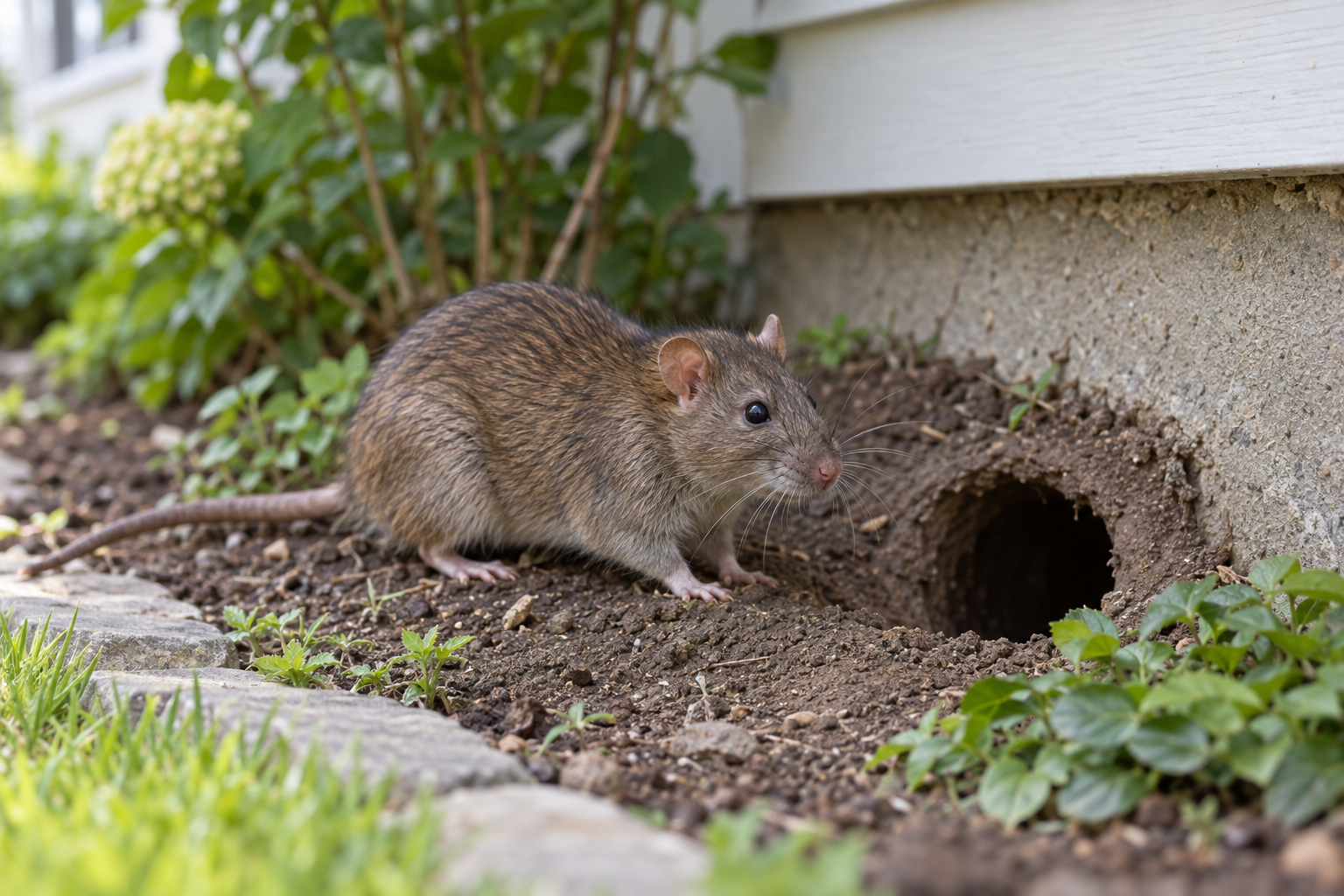
Rat holes in a yard are often rounded openings about 2 to 4 inches across, especially near structures or ground-level cover. Photograph and measure the opening from outside, but don’t reach into it or assume one hole proves rats are present.
Quick answer: A likely rat burrow has a smooth, worn entrance near a foundation, shed, deck, rubbish area, or dense vegetation. Fresh soil and nearby runways strengthen the identification, but similar holes can belong to other animals.
Signs a Hole Could Be a Rat Burrow
Norway rats are the rats most commonly associated with underground burrows around homes. Their main burrow entrance is generally 2 to 4 inches wide and may look round or slightly oval.
Look for several clues together:
- Smooth, compacted soil around the opening
- An entrance kept clear of leaves, cobwebs, or loose debris
- Fresh soil pushed outward, sometimes in a fan shape
- A worn path through grass or vegetation
- One or two smaller, concealed escape openings nearby
- Fresh tracks, droppings, gnaw marks, or greasy rub marks
- A rat seen entering or leaving the opening
Common locations include the edges of foundations, slabs, sidewalks, sheds, decks, gardens, woodpiles, compost areas, garbage storage, and thick vegetation.
Soil shape alone isn’t reliable. Rain, erosion, landscaping, and foot traffic can alter an entrance. An older burrow may also be reopened without producing a large pile of fresh soil.
Burrows and Building Entry Holes Are Different
A burrow entrance leads into the soil. A building entry hole is a gap or gnawed opening that lets an animal enter a wall, crawl space, garage, or home.
Inspect doors, vents, damaged screens, foundation gaps, and places where pipes or cables enter the building. These openings may be part of the same rat problem, but they are not underground burrows.
Roof rats usually nest above ground in trees, dense vegetation, attics, walls, or ceilings. They can occasionally burrow, so nest location does not identify the species with certainty.
How to Check Whether a Rat Hole Is Active
Monitor the opening without disturbing the tunnel. Loosely place dry leaves, crumpled paper, or a small amount of loose soil across the entrance, then check it after a day or two of suitable weather.
A cleared or reopened entrance indicates current animal activity. It does not prove which animal is using it. A motion-activated camera can provide better evidence when several burrowing species occur locally.
Never put your hand into a hole or reach beneath a slab or deck. Don’t probe nesting material or position your face close to the entrance.
Rat Holes in a Yard Versus Common Lookalikes
Compare the full pattern rather than relying on diameter alone:
- Chipmunks: Openings are often around 2 inches wide and near walls, stumps, rocks, or brush. There may be little visible soil because chipmunks carry it away.
- Voles: Look for narrow surface runways through grass, numerous small openings, and clipped vegetation.
- Moles: Raised surface ridges and rounded or volcano-shaped soil mounds are more typical than a maintained open entrance.
- Pocket gophers: These animals usually leave fan-shaped or crescent-shaped mounds with plugged entrances. Their regional range varies.
- Groundhogs: Main entrances are much larger, often 10 to 12 inches wide, with a substantial soil mound.
- Squirrels, skunks, or raccoons: Feeding activity usually creates shallow pits or scattered turf damage rather than one maintained tunnel entrance.
Remove the Conditions Rats Use
Correct likely food and shelter sources while you monitor the opening. These steps help even if identification remains uncertain.
Secure garbage and compost, remove fallen fruit, and clean up spilled birdseed. Bring pet food and water indoors after feeding. Reduce yard clutter, store firewood neatly off the ground where practical, and thin dense vegetation around suspected entrances.
Don’t immediately fill an active-looking burrow. Animals may reopen it, create another exit, or move toward the building. Permanent closure should follow successful control and a monitoring period with no reopening.
If you find droppings or nesting material, don’t sweep or vacuum it dry. Follow current public-health guidance for wet disinfection and seek qualified help for heavy contamination.
Avoid Improvised Burrow Treatments
Don’t pour poison, fuel, bleach, ammonia, boiling water, mothballs, or homemade mixtures into a hole. Avoid flooding, smoke bombs, fire, exhaust hoses, and improvised gas devices. Burrows can extend beneath buildings, making these methods dangerous.
Any trap must match the confirmed rodent and remain inaccessible to children, pets, and wildlife. If considering rodenticide, use only a product labeled for that pest and location, and follow the complete current label. Indoor-only products cannot be placed beside an outdoor burrow.
When to Request a Professional Inspection
Professional help is appropriate when several holes are active, new openings keep appearing, or burrows extend beneath a foundation, slab, retaining wall, or deck support. It is also sensible when rats or fresh signs appear indoors, identification remains uncertain, or traps cannot be secured from children, pets, poultry, or wildlife.
Arrange an inspection for heavy contamination, repeated control failure, or possible soil movement beneath hardscape or a structure. If you rent or live in a shared building, document the openings and activity so the landlord or property manager can coordinate action.
Keep dated photographs, measurements, camera footage, and notes about reopened entrances. This record will show whether conditions are improving and give an inspector better evidence than the hole’s appearance alone.