

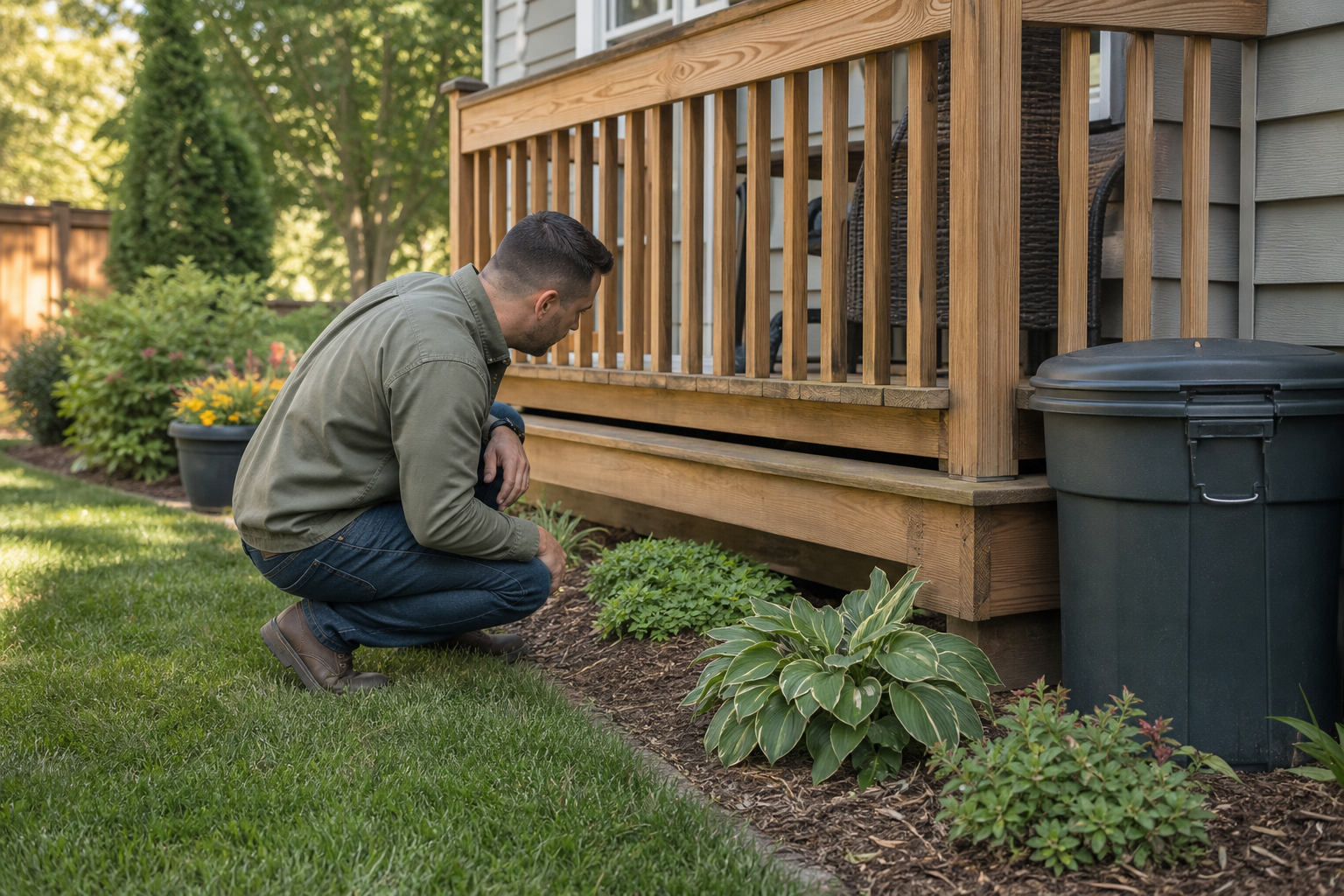
The best way to get rid of skunks in your yard is to remove food sources, confirm whether they have a den, and block access only after the space is empty. Don’t approach, corner, poison, or seal in a skunk. Trapping and relocation rules vary, so recurring or occupied dens are usually best handled by a local wildlife professional.
Quick answer: Secure garbage and pet food tonight, remove spilled birdseed, and watch from indoors to learn where the skunk enters. If it may be living under a deck, shed, or porch, confirm the den is empty before closing the opening.
First, determine why the skunk is visiting
A skunk crossing the yard once may simply be passing through. Repeated visits, digging, or a consistent path toward a structure suggest that your property offers food or shelter.
Check for these common attractants:
- Pet food or water left outside overnight
- Unsecured garbage, recycling residue, or compost
- Fallen fruit and accessible vegetable beds
- Birdseed scattered beneath feeders
- Grubs, insects, rodents, or eggs near poultry areas
- Openings beneath decks, porches, sheds, or additions
- Brush piles, lumber stacks, and other sheltered spaces
Small, cone-shaped holes in a lawn can result from skunks searching for insects, but digging alone does not confirm the animal. Raccoons, squirrels, armadillos, and other wildlife may disturb turf differently depending on your region.
A skunk seen during daylight is not automatically rabid. It may be searching for food or caring for young. Keep your distance and contact animal control if it appears disoriented, unusually aggressive, partly paralyzed, excessively tame, or unable to move normally.
Remove food and water first
Removing attractants is the lowest-risk way to make your yard less useful to skunks.
Bring pet bowls inside before dusk. Use garbage cans with secure lids, and clean food residue from the outside of containers. Pick up fallen fruit and spilled seed regularly. Keep compost in a sturdy, covered system that wildlife cannot enter.
If you feed birds, reduce seed reaching the ground or pause feeding while activity continues. Close poultry securely at night and store feed in wildlife-resistant containers.
Treating a lawn for grubs is not automatically necessary. Confirm that grubs are present and damaging the turf before considering any pesticide. If treatment is justified, use only a product labeled for that pest and site, and follow the complete current label. Protect children, pets, pollinators, and nearby water as directed.
Check carefully for a skunk den
Skunks commonly shelter beneath decks, porches, sheds, and other low structures. Look from a safe distance for a worn path, disturbed soil, hair near an opening, or repeated nighttime entry.
Do not crawl underneath a structure or reach into an opening. Avoid placing your face near the entrance.
One cautious way to check an opening is to loosely place crumpled paper or another light material at the entrance during the day. Observe it from indoors or at a distance for several nights. A moved plug suggests that an animal is still using the space.
This check is not enough if you hear movement, see repeated activity, or suspect young are present. Skunks often raise young in dens during spring and early summer, although timing varies by climate. Sealing a mother outside can leave young trapped beneath the structure.
How to get rid of skunks in your yard with exclusion
Once you have good reason to believe the space is vacant, close the opening promptly. Use durable materials suited to the structure, such as solid skirting or heavy-gauge metal mesh secured without sharp exposed edges.
Skunks can dig at the base of a barrier. A proper wildlife-exclusion barrier usually extends below ground and turns outward to discourage digging, but the needed depth and construction depend on the soil and structure. A wildlife professional can install it where digging, utility lines, or limited access make the work unsafe.
Inspect the full perimeter before sealing anything. Closing the obvious entrance while leaving another gap can move the problem rather than solve it.
One-way wildlife doors should not be installed casually. They can separate a mother from dependent young, may trap another animal inside, and are regulated in some places. Confirm local rules and species timing before using one.
Use deterrents as temporary support
Motion-activated lights or sprinklers may discourage a visiting skunk while you correct the food or shelter problem. Their effect can fade as wildlife becomes accustomed to them, so they should support exclusion rather than replace it.
Do not scatter mothballs outdoors or place them in a den. Mothballs are pesticides with specific labeled uses, and their fumes can harm people and animals when misused. Avoid homemade chemical mixtures, poison, smoke, flooding, and attempts to force a skunk from cover.
Keep dogs leashed during active periods and supervise them outside after dark. Maintain current rabies vaccination as advised by your veterinarian.
When to contact a wildlife professional
Get help from local animal control or a qualified wildlife-control professional when:
- A skunk is currently beneath an occupied structure
- You suspect a mother and young are present
- The den entrance is difficult or dangerous to reach
- Exclusion attempts have failed
- The animal behaves abnormally or cannot move properly
- A skunk is trapped, injured, or inside a building
- You are considering capture or relocation
Wildlife trapping, dispatch, and relocation laws differ by state and locality. Relocation may be restricted or prohibited, and handling a trap creates a serious spray and bite risk. A professional should explain the legal method, check for young, and identify how the opening will be repaired.
If anyone is bitten or scratched, or skunk saliva reaches the eyes, mouth, or broken skin, wash the area promptly with soap and water and contact a medical professional or local public-health authority immediately. Keep people and pets away from the animal rather than trying to capture it.
Start tonight by securing outdoor food and observing the yard from indoors. Once you know whether the skunk is passing through or using a den, you can choose exclusion without trapping an animal inside.
