
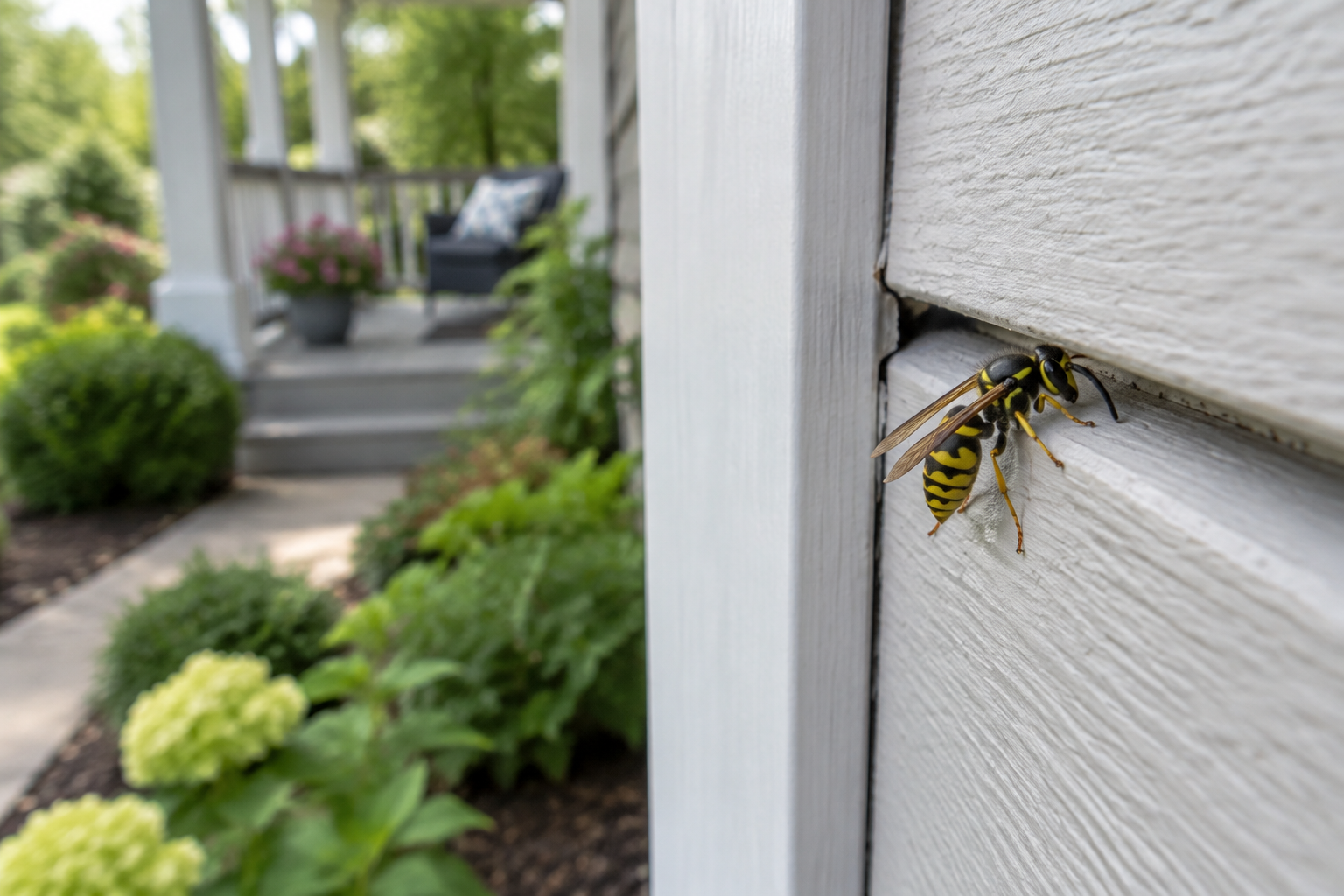
Seeing wasps around your house doesn’t necessarily mean there’s a nest in the building. First, move people and pets away, pause nearby mowing or trimming, and watch from a protected distance. Scattered insects around flowers or food may be foraging. Repeated traffic through one fixed opening is stronger evidence of a nest, but don’t approach, block, or disturb that entrance.
Quick answer: Remove accessible food attractants and monitor scattered activity. Keep the area clear and seek qualified help if insects repeatedly enter a wall, ground hole, vent, soffit, or other cavity.
Look for a traffic pattern, not just one insect
The most useful clue is where the insects go. Foragers may move among flowers, garbage, fallen fruit, pet food, grills, and outdoor drinks without revealing where their colony is located.
A likely nest entrance has regular two-way traffic. Multiple insects enter and leave the same ground hole, siding gap, soffit opening, vent, shrub, or enclosed area. Watch only from far enough away that you aren’t standing in their flight path.
One insect indoors or several around flowers remains ambiguous. Workers repeatedly appearing near the same interior wall, ceiling, vent, or window provide more reason to suspect a structural nest.
Yellowjackets, paper wasps, and look-alikes
Color alone cannot reliably identify a stinging insect. Several wasps have similar yellow-and-black markings, while bees and solitary wasps may also be mistaken for social wasps.
Use these observations as clues rather than a certain identification:
- Yellowjackets usually have compact, smooth bodies. Depending on the species, they may nest underground, inside wall or attic spaces, or in enclosed aerial nests.
- Paper wasps are often slender, with long legs visible during flight. Their exposed nests usually consist of a single open paper comb without an outer covering.
- Aerial nesters may make enclosed paper nests in trees, shrubs, or on buildings. Don’t approach a large nest to examine it more closely.
- Bees and solitary wasps can resemble social wasps from a distance. Body hair, shape, nest form, and repeated traffic may help, but one photograph may not settle the identification.
If identification matters, take a zoomed photograph from a safe position. Don’t catch, swat, or follow an insect toward a suspected nest.
Check these areas without approaching
Start with places attracting foragers. Look for uncovered food, open drink containers, sugary spills, ripe or fallen fruit, exposed pet food, and garbage without a tight lid.
Next, observe the home and yard from normal walking areas. Check for concentrated activity around:
- Ground holes, landscape timbers, shrubs, and sheds
- Eaves, roof edges, soffits, and siding gaps
- Vents and openings around pipes or utility lines
- Attic areas, wall openings, and indoor windows
- Doorways, walkways, play spaces, and regular mowing routes
Don’t climb a ladder, enter an attic or crawlspace, probe a hole, strike a wall, or move branches to improve your view. If insects are concentrated around an area, mark it from a distance so no one accidentally mows, digs, trims, or plays there.
Reduce attractants and monitor wasps around the house
Cover outdoor food until serving and clear leftovers promptly. Check open cans, cups, and bottles before drinking. Clean spills, collect fallen fruit, bring pet food inside, and use sound garbage containers with tight-fitting lids.
Then monitor whether activity changes. Insects that disperse after food and waste are removed were likely visiting an attractant. Continued traffic into one specific point suggests the source is a nest rather than food alone.
Traps aren’t reliable proof that a colony has been eliminated. Their effectiveness depends on the species and lure, and captured insects don’t reveal whether a nearby nest remains active.
What not to do around a suspected nest
Never seal an active wall, soffit, or vent opening. Insects trapped inside the cavity may search for another exit and emerge into occupied rooms.
Also avoid pouring fuel, cleaners, boiling water, or homemade mixtures into a hole. Don’t burn, flood, dig up, vacuum, strike, or dismantle an occupied nest. Blind spraying into a wall or treating from a ladder, roof, attic, or confined space creates additional exposure without confirming that the colony has been reached.
If you consider a pesticide, its current complete label must list the pest and exact setting. Follow every direction and restriction concerning application, protective equipment, children, pets, water, pollinators, re-entry, storage, and disposal.
When professional help is the safer choice
Arrange qualified help when repeated traffic leads into a wall, attic, roof, soffit, vent, chimney area, utility opening, or other hidden space. Underground nests near walkways, doors, play areas, mowing routes, or required work areas also present a high chance of accidental disturbance.
Professional assessment is also appropriate when:
- Wasps are emerging inside occupied rooms.
- The nest is high, enclosed, unusually large, or difficult to reach.
- Access would require a ladder, digging, roof work, or opening a wall.
- You cannot distinguish wasps from bees or another insect requiring a different response.
- A previous control attempt failed.
- Anyone nearby has a known severe sting allergy or cannot quickly leave the area.
- The activity affects a shared entrance, multifamily property, school, or workplace.
If a sting causes breathing difficulty, throat or tongue swelling, faintness, or severe symptoms throughout the body, seek emergency medical help. For a suspected pesticide exposure in the United States, follow the label’s first-aid directions and contact Poison Control at 1-800-222-1222.
Choose the next action from the evidence
For scattered insects, remove food and waste attractants, then monitor from a distance. For steady traffic at one entrance, keep people and pets clear and document the location without approaching. Hidden, underground, high, or unavoidable nests should remain undisturbed while you arrange an appropriate professional assessment.