
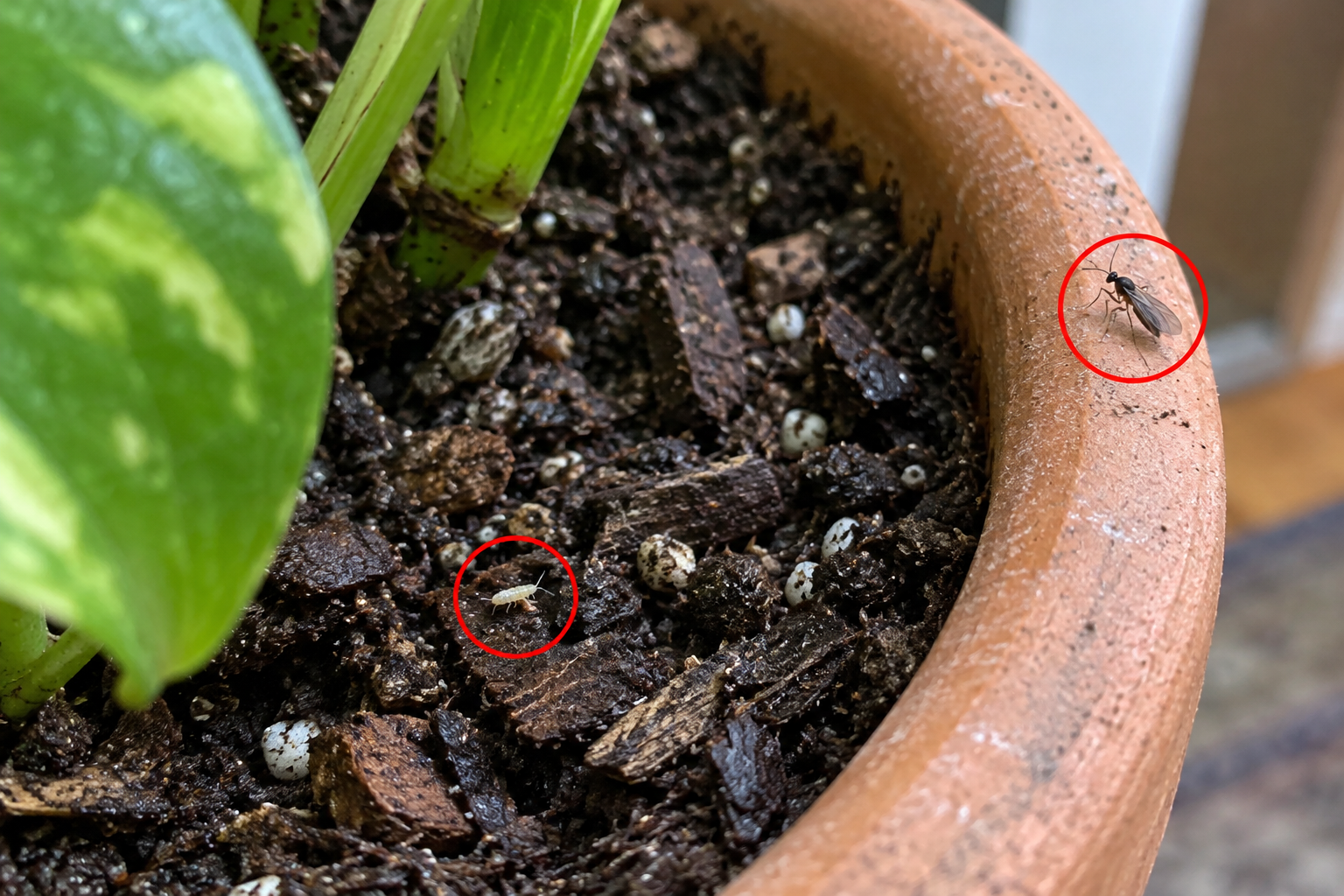
The easiest way to distinguish springtails from fungus gnats is to watch how they move. Springtails jump but don’t fly, while adult fungus gnats fly around plants on delicate wings. Before applying any pesticide, inspect the insects and let overly wet potting mix dry as much as the plant can tolerate.
Quick answer: An insect that springs away when disturbed is probably a springtail. A tiny, dark, long-legged fly hovering near the pot is more likely a fungus gnat.
Springtails vs. fungus gnats at a glance
These pests often appear together with the same underlying condition: consistently damp potting mix. Their appearance, behavior, and potential effects are different.
- Springtails: Tiny, wingless insects that crawl and jump. They usually gather on moist soil, inside saucers, or around drainage holes.
- Adult fungus gnats: Small, dark flies with long legs and antennae. They make short, weak flights around pots and nearby windows.
- Fungus gnat larvae: Slender, pale or nearly transparent larvae with distinct dark heads. They remain in damp potting mix, so you may never notice them.
- Main concern: Springtails are usually harmless decomposers. Fungus gnat larvae can injure delicate roots when populations are high, particularly on seedlings and cuttings.
A single photo may not show enough detail for a confident identification. Movement and location generally provide stronger clues.
Use movement as your first identification check
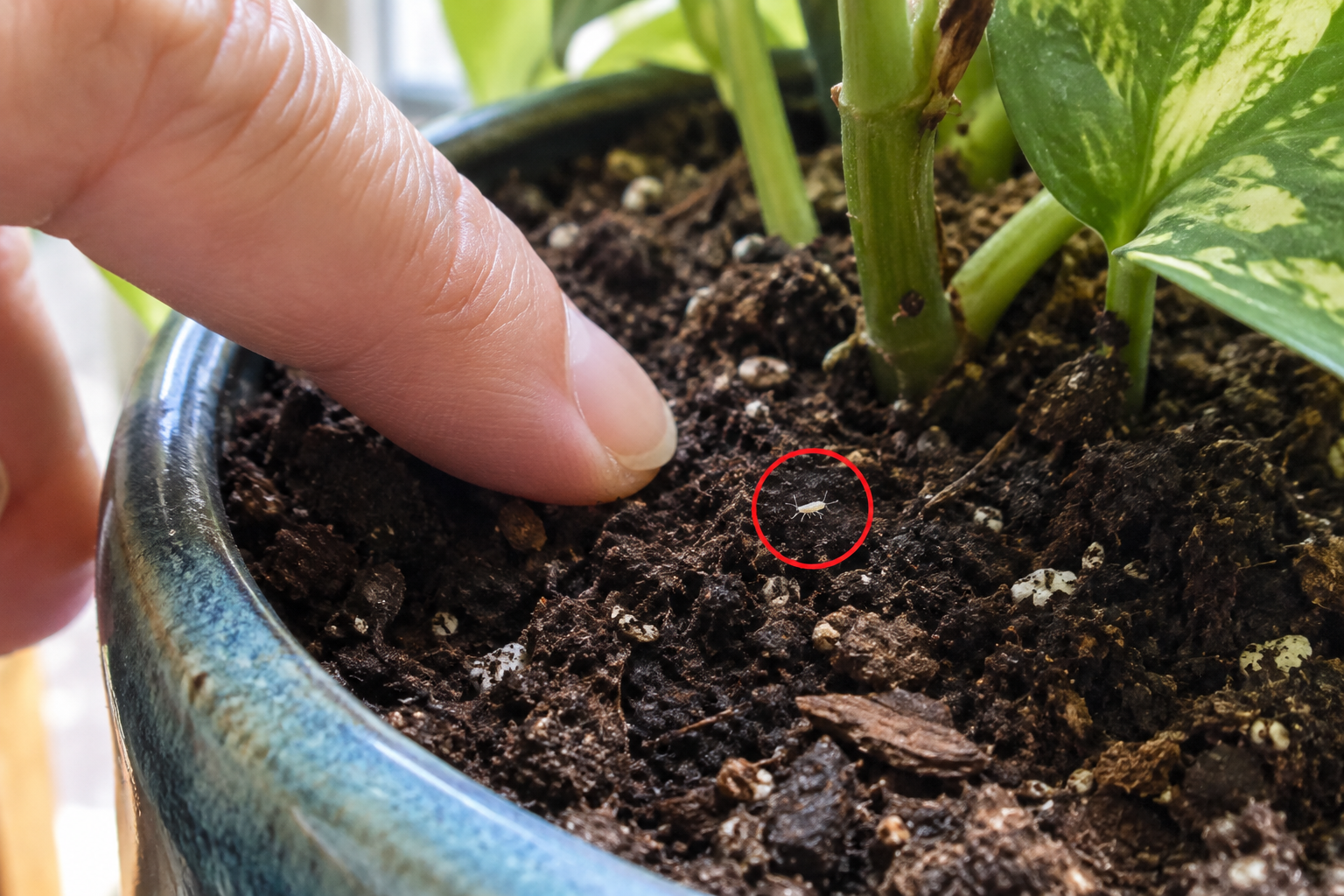
Gently disturb the top of the potting mix while watching closely. Springtails often disappear in sudden hops that look like tiny specks popping from the soil. They use a forked structure beneath the body to launch themselves.
Fungus gnats don’t jump in the same way. Adults may run briefly across the soil, but they usually take flight when disturbed. Their flight is slow and somewhat erratic rather than quick and direct.
Also check the saucer after watering. Springtails may float or move across standing water because their bodies repel water. Fungus gnat adults are more likely to rest on the pot, foliage, wall, or window.
Compare their appearance
Springtails are commonly about the size of a grain of sand or slightly larger. Depending on the type, they may look white, gray, tan, brown, or nearly black. Their small size can make body shape difficult to see without magnification.
Adult fungus gnats resemble miniature mosquitoes. They have narrow bodies, long legs, noticeable antennae, and one pair of clear or smoky wings. They are usually easier to recognize when one lands on a light-colored surface.
Don’t confuse either insect with whiteflies. Whiteflies have powdery white wings and usually rise from plant leaves, not the potting mix, when disturbed.
What their location tells you
Insects concentrated on wet soil, saucers, or drainage holes are more likely to be springtails. They feed mainly on fungi, algae, decaying plant material, and other organic matter associated with moisture.
Flying insects repeatedly returning to the soil suggest fungus gnats. Adults lay eggs in moist growing media, where the larvae feed on fungi and organic material. Larvae may also feed on fine roots when numerous.
Yellow sticky cards placed near the plant can help confirm flying fungus gnat adults. They won’t solve the moisture problem or control larvae in the soil, but they make adult activity easier to track. Keep sticky materials where children and pets cannot contact them.
Correct the moisture problem first
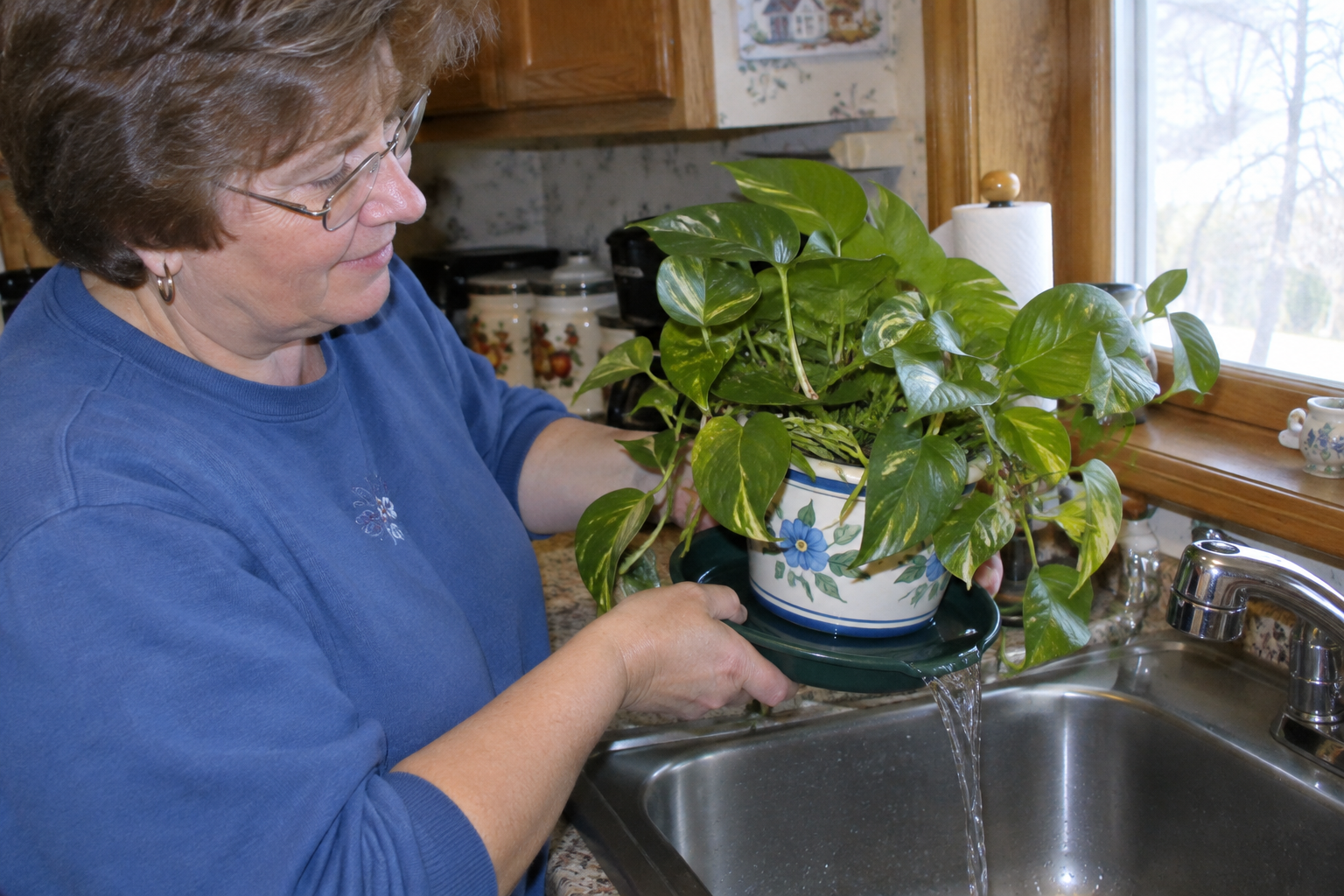
Allow the upper layer of potting mix to dry before watering again, provided that approach suits the plant. Moisture needs differ, so don’t deliberately wilt a moisture-loving species just to dry its pot.
Check for conditions that keep the root zone wet:
- Water left standing in a decorative outer pot or saucer
- A container without usable drainage holes
- Dense or compacted potting mix
- A pot much larger than the root system
- Watering on a schedule instead of checking the soil
- Dead leaves or plant debris covering the surface
Empty collected water and improve drainage where possible. If the mix stays saturated, smells sour, or has broken down into a dense mass, repotting into fresh mix and a suitable container may be reasonable. Avoid moving insects to other plants by cleaning the work area and not reusing infested potting mix.
Do you need to treat springtails?
A few springtails usually don’t require direct treatment. Reducing excess moisture and removing decaying debris often lowers their numbers. Their presence is more useful as a warning that the area remains damp.
Large numbers indoors may indicate a moisture problem extending beyond the flowerpot. Inspect nearby leaks, wet windowsills, damp flooring, and condensation. Correcting that source is more effective than repeatedly killing visible insects.
When fungus gnats need more attention
Continue monitoring if adult gnats remain active after watering practices improve. Drying the surface interrupts favorable larval conditions, but eggs and larvae already present may take time to disappear.
For persistent activity, consider a control specifically labeled for fungus gnats and the exact indoor plant setting. Follow the complete current label, including placement and household precautions. General household sprays aimed into the room or onto soil may miss the larvae and create unnecessary exposure.
Get expert help if plants decline despite corrected care, the identification remains uncertain, or flying insects are spreading through a large indoor plant collection. For an ordinary potted plant, however, the best next step is simple: observe whether the insects jump or fly, then correct the damp conditions supporting them.